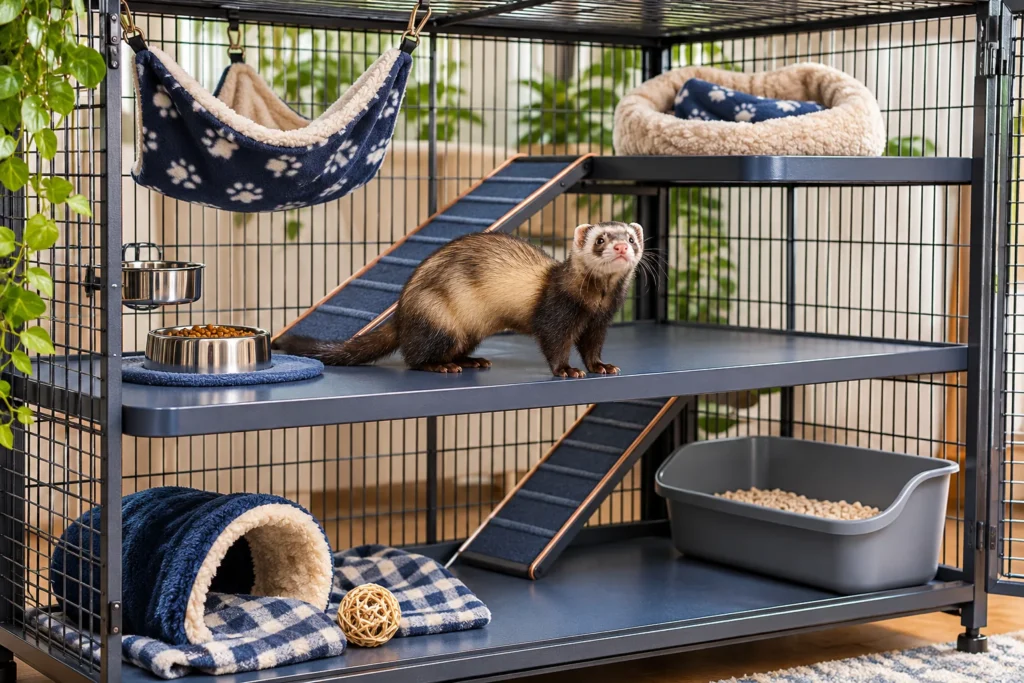
A ferret cage should be as spacious as you can reasonably provide, with solid flooring, secure doors, room for sleeping, feeding and toileting, and space to move comfortably. Published minimum-size recommendations vary considerably, so don’t choose a cage based on dimensions alone. A large, well-designed enclosure is better than a cramped cage with several tiny shelves, and ferrets still need several hours of supervised exercise outside their cage every day.
What Size Cage Does a Ferret Need?
Ferrets may spend a remarkable amount of time sleeping, but when they’re awake, they have places to go, things to investigate and absolutely no intention of sitting quietly.
Their cage needs to provide a comfortable, secure home base rather than simply somewhere to keep them between play sessions.
You’ll find different minimum cage sizes recommended by different animal-care organizations. For example, VCA Animal Hospitals suggests a minimum of 24 × 24 × 18 inches, while the Merck Veterinary Manual’s pet-owner guidance recommends at least 36 × 36 × 24 inches.
Meanwhile, the PDSA recommends a much larger overall living environment, with at least 10 square metres of floor space for a pair of ferrets.
These recommendations aren’t directly equivalent: some describe a cage used during confinement, while others address the ferret’s overall living environment.
Our advice is to prioritize generous usable space, a safe layout and plenty of daily access to a larger ferret-proofed exercise area. Treat small cage dimensions as a starting point for comparison, not a target to aim for.
Why Usable Floor Space Matters More Than Height
Multi-level ferret cages are popular, and additional levels can provide useful opportunities to climb and explore.
However, a tall cage with several narrow shelves doesn’t necessarily provide much room to move around.
Look at the actual space available on each level. Can your ferret turn around comfortably? Is there room to walk without constantly climbing over bowls, beds or litter trays?
Wide platforms are generally more useful than tiny perches. They also make it easier to arrange the cage without forcing everything into one crowded corner.
Height can add variety, but it shouldn’t come at the expense of usable space or safety.
Are Multi-Level Ferret Cages Better?
A well-designed multi-level cage can be an excellent choice, particularly when it provides broad platforms connected by safe ramps.
Look for:
- Large, stable platforms with solid surfaces
- Ramps that are securely attached and easy to climb
- Protected openings between levels
- No long, unprotected drops
- Enough room for your ferret to stand, turn and move naturally
- Doors large enough to make cleaning and rearranging easy
Ferrets can be enthusiastic climbers, but they aren’t always graceful. Poor depth perception and slippery surfaces can make falls a concern.
Don’t assume a cage is safe simply because it’s marketed for ferrets.
How to Arrange a Ferret Cage
A good cage layout gives your ferret distinct areas for sleeping, eating, drinking and using the litter box.
Sleeping Area
Provide a comfortable, dry sleeping space, such as a suitable hammock, fabric bed or enclosed hideout.
Check fabric regularly for loose threads, holes and chewing damage. Remove anything your ferret attempts to eat.
Litter Area
Place a stable, accessible litter box away from food and sleeping areas.
Many ferrets prefer using a corner, so observe your ferret’s habits before settling on a permanent location.
If litter training is proving difficult, see our guide to stopping your ferret from pooping outside the litter box.
Food and Water
Provide reliable access to fresh water and an appropriate ferret diet.
Secure bowls or use heavy, stable containers that your ferret cannot easily overturn.
If water keeps ending up everywhere except the bowl, read Why Does My Ferret Keep Tipping Over Its Water Bowl?
Room to Move and Explore
Leave enough uncluttered space for your ferret to move comfortably.
A few suitable enrichment items are helpful, but filling every available inch with toys doesn’t make the cage better.
Keep larger digging activities and more energetic games for a safe, supervised play area.
What Kind of Flooring Should a Ferret Cage Have?
Choose solid, stable flooring rather than exposed wire mesh.
Wire flooring can be uncomfortable and may injure a ferret’s feet. Solid surfaces are also generally easier to clean.
Make sure the flooring isn’t excessively slippery, and avoid loose coverings that your ferret can pull apart or swallow.
Any liners should be washable, securely positioned and checked regularly for damage.
How Much Space Do Two Ferrets Need?
Two ferrets need more room than one, especially if they’re sharing sleeping areas, food and water stations, and litter facilities.
Look for an enclosure with enough space for both animals to move around and rest separately when they want to.
Additional hammocks, sleeping areas and feeding stations can help reduce competition for resources.
For a pair of ferrets, it’s especially important to provide a generous overall living area rather than relying exclusively on a conventional cage.
And remember: adding another ferret doesn’t automatically mean the original cage is still adequate.
How Long Can a Ferret Stay in Its Cage?
A cage should never replace regular opportunities to explore and exercise.
The Ontario SPCA recommends at least three to four hours of supervised playtime each day, and other animal-welfare organizations similarly emphasize substantial daily activity outside the cage.
That playtime should happen in a properly ferret-proofed area, with dangerous openings, electrical cords, hazardous objects and unsafe furniture access secured.
For example, our guide to keeping ferrets out from under the couch covers one surprisingly common household hazard.
Think of the cage as a safe home base, not your ferret’s entire world.
Where Should You Put a Ferret Cage?
Choose a quiet, well-ventilated location away from direct sunlight, drafts and sources of excessive heat.
Ferrets are particularly vulnerable to overheating, so avoid placing their cage beside sunny windows, radiators or heating vents.
Keep the enclosure somewhere you can easily monitor your ferret, maintain fresh water and clean up regularly.
A good location should also make daily access and supervised play convenient.
Signs Your Ferret’s Cage May Be Too Small
Take another look at your setup if:
- The litter box, food and sleeping areas are crowded together.
- Your ferret has very little clear space to move around.
- Platforms are too narrow to turn around comfortably.
- Ramps and accessories block access to important areas.
- Your ferret cannot comfortably stand or stretch in the available space.
- The enclosure doesn’t allow for separate resting areas when multiple ferrets share it.
Repeated attempts to escape or persistent restless behavior can also signal that the overall environment needs attention, although these behaviors don’t prove the cage is too small by themselves.
More space, better enrichment and regular exercise are all worth considering.
Should You Buy the Biggest Ferret Cage Available?
Generally, more usable space is beneficial, provided the enclosure is safe, secure and practical to maintain.
But size alone doesn’t guarantee quality.
A huge cage with dangerous gaps, exposed wire flooring or poorly designed platforms can be less suitable than a smaller but carefully arranged enclosure paired with a generous exercise area.
Look at the complete setup rather than choosing by advertised dimensions or the number of levels.
The Simple Fix
Choose a spacious, secure cage with solid floors, broad platforms, safe ramps and separate areas for sleeping, feeding and toileting. Then provide several hours of supervised exercise in a larger ferret-proofed space every day.
If you’re comparing two cages, pay attention to the actual usable space rather than the height or number of shelves.
After all, your ferret doesn’t care how impressive its apartment looks in the product photos.
It just wants somewhere comfortable to sleep between attempts to dismantle your house.